
General Principles of Cell Communication & Signaling, Intracellular Signaling Pathway Activation by Extracellular Signal Molecule, Forms of Intracellular Signaling (Contact-Dependent, Paracrine, Synaptic, Endocrine)
Introduction: Why Cell Communication Is the Language of
After teaching cell biology for many years to school, undergraduate, and even postgraduate students, I have realized one important truth: students struggle not because the topic is difficult, but because the logic behind cell communication is not explained clearly.
Every living cell—whether in a unicellular organism or in the human body—must constantly receive, process, and respond to information. This exchange of information is known as cell communication.
In this article, we will deeply explore:
General principles of cell communication & Signaling
Intracellular signaling pathway activation by extracellular signal molecule
Forms of intracellular signaling:
- Contact-dependent
- Paracrine
- Synaptic
- Endocrine
I will explain these concepts step-by-step, using classroom-tested explanations, real biological examples, and conceptual clarity that helps both exam preparation and true understanding.
What Is Cell Communication?
Cell communication refers to the ability of cells to detect signals from their environment, interpret those signals, and respond appropriately.
From my teaching experience, I often tell students:
“Cells behave like intelligent decision-makers. They don’t react randomly; they respond only when the right signal reaches the right receptor.”
Why Cell Communication Is Essential
Cell communication is crucial for:
- Growth and development
- Cell division and differentiation
- Immune responses
- Hormonal regulation
- Neural coordination
- Maintenance of homeostasis
A failure in cell communication can lead to diseases such as cancer, diabetes, autoimmune disorders, and neurological conditions.
General Principles of Cell Communication & Signaling
Understanding the general principles of cell communication makes all signaling pathways easier to learn.
1. Signal Molecules (Ligands)
Signal molecules are chemical messengers that convey information between cells. These include:
- Hormones
- Neurotransmitters
- Growth factors
- Cytokines
- Local mediators (e.g., nitric oxide)
Teaching tip: I often ask students to imagine signal molecules as “emails” sent from one cell to another.
2. Receptors: The Gatekeepers
Cells respond only if they possess specific receptors for a signal molecule.
Receptors may be:
- Cell surface receptors (for hydrophilic signals)
- Intracellular receptors (for lipid-soluble signals)
This explains why:
Insulin affects liver cells but not neurons
Testosterone affects muscle cells but not red blood cells
3. Specificity
Each signal molecule binds to its specific receptor, like a lock-and-key system.
Even closely related molecules can trigger completely different responses depending on the receptor type.
4. Signal Transduction
Signal transduction is the process by which an extracellular signal is converted into an intracellular response.
This involves:
- Receptor activation
- Intracellular signaling cascades
- Amplification of signal
- Activation of target proteins
5. Cellular Response
The final response may include:
- Gene expression
- Enzyme activation
- Changes in membrane permeability
- Cytoskeletal rearrangements
- Cell division or apoptosis
Also Read- ANATOMY AND PHYSIOLOGY | INTRODUCTION TO HUMAN BODY
Intracellular Signaling Pathway Activation by Extracellular Signal Molecule
This is the core concept that students must master.
Step-by-Step Explanation (Teacher’s Perspective)
Over the years, I’ve found that breaking this into clear steps improves understanding dramatically.
Step 1: Signal Reception
An extracellular signal molecule binds to its specific receptor.
Example:
- Insulin binds to insulin receptor
- Adrenaline binds to β-adrenergic receptor
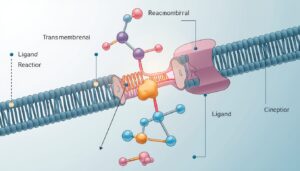
Image- Diagram showing ligand binding to cell surface receptor (General Principles of Cell Communication & Signaling)
Step 2: Receptor Activation
Binding causes:
- Conformational change
- Dimerization (in some receptors)
- Activation of intrinsic enzymatic activity
This converts the receptor into an active signaling unit.
Step 3: Signal Transduction Cascade
Activated receptors trigger a chain of intracellular events involving:
- Second messengers (cAMP, Ca²⁺, IP₃)
- Protein kinases
- Phosphorylation reactions
Teaching insight: One signal molecule can activate thousands of intracellular molecules, a concept called signal amplification.
Step 4: Activation of Effector Proteins
Effector proteins may include:
- Transcription factors
- Metabolic enzymes
- Ion channels
- Cytoskeletal proteins
Step 5: Cellular Response
The cell produces a specific and appropriate response, depending on:
- Cell type
- Signal duration
- Signal strength
- Intracellular context
Also Read- BASIC LIFE PROCESSES | HOMEOSTASIS | ANATOMICAL TERMINOLOGY
Forms of Intracellular Signaling
Now let us explore the forms of intracellular signaling, a section frequently tested in exams and interviews.
a) Contact-Dependent Signaling (Juxtacrine Signaling)
Definition
Contact-dependent signaling occurs when signal molecules remain bound to the surface of the signaling cell and directly interact with receptors on adjacent cells.
Key Characteristics
- Requires direct cell-to-cell contact
- Signal molecule is membrane-bound
- Highly specific and localized
Example
- Notch-Delta signaling during embryonic development
- Immune cell interactions
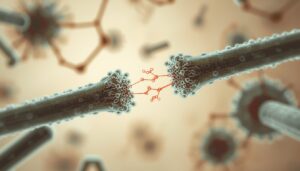
Image- Juxtacrine signaling mechanism (General Principles of Cell Communication & Signaling)
Teaching Insight
I emphasize this as the “handshake” model of communication—no distance, no diffusion.
b) Paracrine Signaling
Definition
In paracrine signaling, cells release signaling molecules that act on nearby target cells.
Key Characteristics
- Short-range signaling
- Rapid response
- Signal molecules degrade quickly
Examples
- Growth factors
- Cytokines
- Nitric oxide (NO)
Special Case: Autocrine Signaling
Sometimes, cells respond to their own signals, known as autocrine signaling.
Example:
Cancer cells promoting uncontrolled growth
Image Prompt: Paracrine signaling showing local diffusion
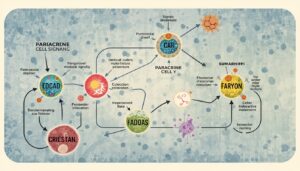
Image- Paracrine cell signaling pathway (General Principles of Cell Communication & Signaling)
c) Synaptic Signaling
Definition
Synaptic signaling occurs in neurons, where electrical signals trigger the release of neurotransmitters across synapses.
Key Characteristics
- Highly specific
- Rapid transmission
- Targeted communication
Process
- Action potential reaches axon terminal
- Neurotransmitter release
- Binding to postsynaptic receptors
- Ion channel opening or closing
Examples
- Acetylcholine
- Dopamine
- Serotonin
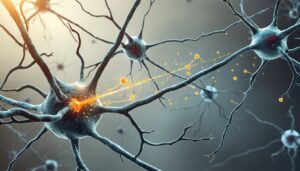
Image- Synaptic transmission and neurotransmitter release (General Principles of Cell Communication & Signaling)
d) Endocrine Signaling
Definition
Endocrine signaling involves hormones released into the bloodstream to act on distant target cells.
Key Characteristics
- Long-range signaling
- Slower response
- Longer-lasting effects
Examples
- Insulin
- Thyroxine
- Adrenaline
- Estrogen
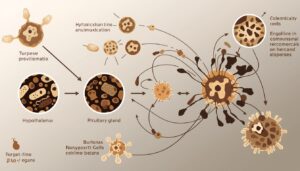
Image- Endocrine cell communication pathway (General Principles of Cell Communication & Signaling)
Teaching Insight
I often explain endocrine signaling as a public announcement system, where only cells with receptors “hear” the message.
Comparison of Forms of Intracellular Signaling
Type Distance Speed Example
Contact-Dependent Direct Very fast Notch signaling
Paracrine Short Fast Growth factors
Synaptic Targeted Very fast Neurotransmitters
Endocrine Long Slow Hormones
Clinical Relevance of Cell Communication
From years of academic exposure, I can confidently say that most diseases originate from faulty signaling:
- Cancer → abnormal growth signaling
- Diabetes → insulin signaling defects
- Autoimmune diseases → immune signaling errors
- Neurological disorders → synaptic signaling issues
Understanding these pathways is not just academic—it is medically transformative.
Also Read- Structure and Functions of Cell | Transport, Division & Junctions
Unit 1 Human Anatomy And Physiology 1 – All Chapter PDF Notes
Frequently Asked Questions (FAQ)
Q1. What are the general principles of cell communication?
The general principles include signal molecules, specific receptors, signal transduction pathways, amplification, and cellular response.
Q2. What is intracellular signaling pathway activation by extracellular signal molecule?
It is the process by which an external signal binds to a receptor and triggers a cascade of intracellular events leading to a cellular response.
Q3. What are the forms of intracellular signaling?
The main forms are:
- Contact-dependent
- Paracrine
- Synaptic
- Endocrine
Q4. Which form of signaling is fastest?
Synaptic signaling is the fastest due to direct neuronal transmission.
Q5. Why don’t all cells respond to the same hormone?
Only cells with specific receptors can respond to a given signal molecule.
Also Read- What Is Pharmacology? Pharmacodynamics and Pharmacokinetics with Examples
Final Thoughts from a Teacher’s Experience
General Principles of Cell Communication & Signaling
After decades of teaching, one thing is clear: cell communication is the foundation of life sciences. Once students grasp the logic behind signaling, topics like physiology, immunology, neurobiology, and pathology become far easier.
If you truly understand the general principles of cell communication, intracellular signaling pathway activation by extracellular signal molecule, and forms of intracellular signaling, you hold the key to modern biology.
Pingback: Tissue Level of Organization: Structure and Functions
Pingback: Skeletal System: Bones, Muscles & Contraction Explained