Integumentary System: Structure and Functions of Skin
Introduction
Having taught human anatomy for more than a decade, one lesson I always emphasize to my students is this: the skin is not just a covering—it’s a living, breathing organ that protects, regulates, and senses.
When we talk about the integumentary system, we’re referring to one of the most essential yet often underestimated systems of the body. It includes the skin, hair, nails, and associated glands—all working together as your body’s first line of defense.
In this article, we’ll explore the structure and functions of skin, understand its layers, and appreciate how this remarkable system maintains our homeostasis and health every single second.
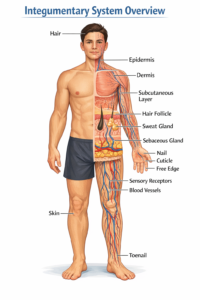
Full-body human diagram showing skin, hair, and nails labeled — “Integumentary System Overview”
1. What is the Integumentary System?
The integumentary system forms the outermost protective barrier of our body. It shields internal tissues from mechanical damage, pathogens, dehydration, and UV radiation.
Major components include:
- Skin – the largest organ of the body
- Hair – protects and insulates
- Nails – strengthen fingertips and toes
- Sebaceous and sweat glands – help in lubrication and thermoregulation
Having dissected countless specimens in biology labs and seen microscopic slides of skin layers, I can tell you—each component has a unique and indispensable role.
Skin: The Largest Organ of the Human Body
Basic Facts About Skin
- Area: ~1.5–2 square meters in adults
- Thickness: 0.5 mm to 4 mm (varies by region)
- Highly vascularized and innervated
- Continuously renewing tissue
The skin is both structurally complex and functionally diverse, which is why understanding its layers is essential.
Also Read- Tissue Level of Organization: Structure and Functions
2. Structure of the Skin
The skin is a complex organ made up of three primary layers:
- Epidermis
- Dermis
- Hypodermis (Subcutaneous Layer)
Each layer has distinct cells and functions, yet they work harmoniously like sections of a symphony.
2.1. Epidermis – The Protective Outer Layer
The epidermis is the outermost layer composed mainly of keratinized stratified squamous epithelium.
It acts as a waterproof shield and a barrier against pathogens.
Key points:
- Avascular (contains no blood vessels)
- Nutrients diffuse from the underlying dermis
- Contains melanocytes (produce melanin pigment), keratinocytes, and Langerhans cells (immune defense)
Layers of the Epidermis (from deep to superficial):
- Stratum basale (germinativum): Produces new skin cells
- Stratum spinosum: Strength and flexibility
- Stratum granulosum: Keratin production
- Stratum lucidum: Found only in thick skin (palms, soles)
- Stratum corneum: Dead keratinized cells that shed regularly
Important Epidermal Cells
- Keratinocytes – Produce keratin
- Melanocytes – Produce melanin pigment
- Langerhans cells – Immune defense
- Merkel cells – Sensory reception
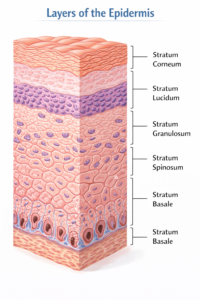
Microscopic cross-section diagram showing the five layers of the epidermis
2.2. Dermis – The Living Support Layer
Beneath the epidermis lies the dermis, which provides strength, elasticity, and nourishment to the skin.
It consists of two regions:
- Papillary layer: Thin and contains capillaries, nerve endings, and touch receptors
- Reticular layer: Thicker, made of dense irregular connective tissue containing collagen and elastin fibers
The dermis houses important structures:
- Hair follicles
- Sebaceous (oil) glands
- Sweat glands
- Blood vessels
- Sensory receptors
These components maintain temperature regulation, wound healing, and sensory perception.
2.3. Hypodermis – The Cushion Layer
The hypodermis, or subcutaneous tissue, connects the skin to underlying muscles and organs.
It contains adipose (fat) tissue, which:
- Acts as an insulator
- Provides energy storage
- Cushions the body against shocks
Functions of Hypodermis
- Fat storage
- Thermal insulation
- Shock absorption
- Anchors skin to muscles
While not officially part of the skin, the hypodermis plays a critical supporting role in maintaining temperature and absorbing mechanical impacts.
Also Read- ANATOMY AND PHYSIOLOGY | INTRODUCTION TO HUMAN BODY
3. Functions of the Skin
After decades of explaining this to students, I often compare the skin to a multi-talented guardian—it’s protective, sensory, and self-sustaining. Let’s go layer by layer through its major functions.
3.1. Protection
The epidermis forms a barrier against:
- Mechanical injury
- Microbial invasion
- Chemical irritants
- Harmful UV radiation
The melanin pigment absorbs UV rays, preventing DNA damage in skin cells.
3.2. Temperature Regulation
Through sweat production and blood vessel dilation/constriction, the skin maintains optimal body temperature:
- Vasodilation (vessels widen) → releases heat
- Vasoconstriction (vessels narrow) → conserves heat
Sweat glands also help cool the body through evaporation.
3.3. Sensory Reception
Embedded within the dermis are specialized sensory receptors that detect:
- Touch (Meissner’s corpuscles)
- Pressure (Pacinian corpuscles)
- Temperature (Thermoreceptors)
- Pain (Nociceptors)
These signals help us react quickly to environmental changes, preventing injury.
3.4. Excretion and Secretion
Through sweat glands, the skin excretes:
- Water
- Salts
- Urea
- Ammonia
Meanwhile, sebaceous glands secrete sebum, an oily substance that:
- Keeps the skin soft and waterproof
- Has antibacterial properties
3.5. Vitamin D Synthesis
When exposed to sunlight, the skin synthesizes Vitamin D from cholesterol precursors—essential for calcium absorption and bone health.
I often tell students: a few minutes of morning sunlight is not just refreshing—it’s biochemical magic in action.
3.6. Immunological Defense
Skin cells, especially Langerhans cells, detect and fight off pathogens.
This local immune surveillance helps prevent infections before they spread deeper into the body.
Also Read- BASIC LIFE PROCESSES | HOMEOSTASIS | ANATOMICAL TERMINOLOGY
4. Accessory Structures of the Integumentary System
4.1. Hair
- Provides insulation and protection
- Each hair grows from a hair follicle located in the dermis
- Growth cycle includes anagen (growth), catagen (transition), and telogen (rest) phases
4.2. Nails
- Made of hard keratin
- Protect fingertips and aid in tactile sensation
4.3. Glands
- Sebaceous glands: Secrete sebum for lubrication
- Eccrine glands: Control temperature via sweat
- Apocrine glands: Found in axillary and genital regions, activated during stress or hormonal changes
5. Clinical Relevance of Skin Health
Over the years, I’ve seen students and patients overlook skin health, assuming it needs minimal care. However, skin disorders can often be the first sign of systemic disease.
Common conditions include:
- Acne: Overactive sebaceous glands
- Psoriasis: Overproduction of skin cells
- Eczema: Inflammatory skin reaction
- Skin cancer: Uncontrolled cell growth due to UV exposure
A balanced diet, hydration, and sunscreen use can dramatically preserve skin health.
6. Summary Table
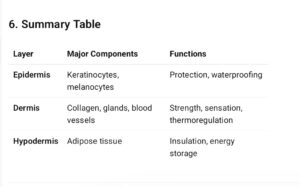
Unit 2 Human Anatomy And Physiology 1 – All Chapter PDF Notes
7. FAQs on Integumentary System, Structure and Functions of Skin
Q1. What is the integumentary system composed of?
It consists of the skin, hair, nails, and glands that protect and regulate the body’s environment.
Q2. What are the main functions of the skin?
The skin provides protection, temperature regulation, sensory detection, excretion, and vitamin D synthesis.
Q3. Which layer of skin is responsible for new cell growth?
The stratum basale of the epidermis constantly generates new skin cells.
Q4. Why is the skin called the largest organ?
It covers approximately 1.5–2 square meters in adults and performs multiple essential functions for survival.
Q5. How does the integumentary system help maintain homeostasis?
By regulating temperature, preventing water loss, and acting as a barrier against pathogens, it keeps the body in balance.
Final Thoughts
After years of teaching anatomy, I’ve realized that understanding the skin deepens our appreciation for how intricately designed the human body is.
The integumentary system may seem external, but its functions are deeply internal—guarding, sensing, and sustaining life itself.
Take care of your skin, and it will take care of you.
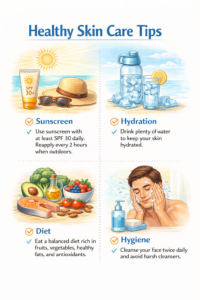 “Healthy Skin Care Tips” infographic – sunscreen, hydration, diet, hygiene