
Structure and Functions of Cell, Transport Across Cell Membrane, Cell Division, Cell Junctions
Biology becomes truly fascinating when we understand that every living organism—whether a microscopic bacterium or the human body—is built from cells. Over my many years of teaching biology to school and undergraduate students, I’ve observed that once students grasp cell structure and its functional logic, the rest of biology starts making sense naturally.
In this detailed guide, we will explore:
- Structure and Functions of Cell
- Transport across cell membrane
- Cell division
- Cell junctions
This article is written not just to help you memorize facts, but to understand concepts deeply, jus
1. Structure and Functions of Cell
What Is a Cell?
A cell is the smallest structural and functional unit of life. Every cell performs essential activities such as metabolism, growth, and reproduction. When I introduce this concept to students, I often say:
“A cell is like a miniature factory—each organelle has a specific department and responsibility.”
Types of Cells
Cells are broadly classified into:
- Prokaryotic Cells – No true nucleus (e.g., bacteria)
- Eukaryotic Cells – True nucleus and membrane-bound organelles (plant and animal cells)
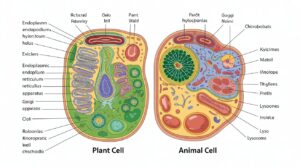
Cell Organelles and Their Functions
Nucleus
- Control center of the cell
- Contains DNA
- Regulates cell division and protein synthesis
Teaching tip: Students remember this easily when I compare it to a school principal controlling activities.
Mitochondria
- Powerhouse of the cell
- Produces ATP via cellular respiration
Endoplasmic Reticulum (ER)
- Rough ER: Protein synthesis
- Smooth ER: Lipid synthesis and detoxification
Golgi Apparatus
- Modifies, packages, and transports proteins
Lysosomes
- Digest waste materials
- Known as “suicide bags” of the cell
Chloroplast (Plant Cells)
- Site of photosynthesis
- Contains chlorophyll
Cell Wall (Plant Cells)
- Provides rigidity and protection
[Image: Cell membrane fluid mosaic model]
Also Read- ANATOMY AND PHYSIOLOGY | INTRODUCTION TO HUMAN BODY
2. Transport Across Cell Membrane
“The cell membrane is selectively permeable—it decides what enters and exits.”
Structure of Cell Membrane
- Phospholipid bilayer
- Embedded proteins
- Described by the Fluid Mosaic Model
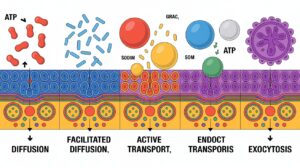
Types of Transport Across Cell Membrane
Passive Transport (No Energy Required)
1. Diffusion
Movement from high to low concentration
2. Facilitated Diffusion
Uses carrier or channel proteins
3. Osmosis
Movement of water through a semipermeable membrane
Classroom insight: Osmosis becomes clear when students visualize potato strips in salt solution.
Active Transport (Energy Required)
- Moves substances against concentration gradient
- Requires ATP
- Example: Sodium-Potassium Pump
Vesicular Transport
Endocytosis
- Phagocytosis (solid)
- Pinocytosis (liquid)
Exocytosis
- Release of materials outside the cell
[Image: Types of membrane transport]
Also Read- BASIC LIFE PROCESSES | HOMEOSTASIS | ANATOMICAL TERMINOLOGY
3. Cell Division
Cell division is essential for growth, repair, and reproduction. I tell my students:
“Life continues because cells know how to divide correctly.”
Types of Cell Division
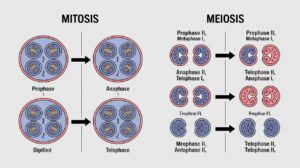
Mitosis – Division for Growth
Occurs in somatic cells and produces two identical daughter cells.
Stages of Mitosis:
- Prophase
- Metaphase
- Anaphase
- Telophase
- Cytokinesis
Meiosis – Division for Reproduction
- Occurs in germ cells
- Produces four haploid cells
- Increases genetic variation
Key Features:
- Crossing over
- Independent assortment
- Reduction division
[Image: Stages of mitosis and meiosis]
4. Cell Junctions
Cell junctions are often overlooked, but they are critical for tissue integrity and communication. I stress this especially for medical and life science students.
Types of Cell Junctions
1. Tight Junctions
- Prevent leakage
- Found in intestinal lining
2. Adherens Junctions
- Provide mechanical support
- Link actin filaments
3. Desmosomes
- Strong cell-to-cell adhesion
- Found in skin and heart muscle
4. Gap Junctions
- Allow direct communication
- Exchange of ions and small molecules
Importance of Understanding Cell Biology
From years of experience, I can confidently say:
- Cell biology is the foundation of medicine
- Understanding transport explains drug action
- Cell division errors explain cancer
- Cell junction defects explain genetic diseases
Once students understand these topics, advanced biology becomes far easier.
Also Read- What Is Pharmacology? Pharmacodynamics and Pharmacokinetics with Examples
Unit 1 Human Anatomy And Physiology 1 – All Chapter PDF Notes
FAQs – Structure and Functions of Cell, Transport Across Cell Membrane, Cell Division, Cell Junctions
What is the structure and function of a cell?
A cell consists of organelles like nucleus, mitochondria, ER, Golgi apparatus, each performing specialized functions essential for life.
What are the main types of transport across cell membrane?
Passive transport, active transport, and vesicular transport (endocytosis and exocytosis).
Why is cell division important?
Cell division enables growth, tissue repair, and reproduction while maintaining genetic continuity.
What are cell junctions and why are they important?
Cell junctions connect cells, provide strength to tissues, and enable communication between neighboring cells.
Which cell junction allows communication?
Gap junctions allow direct exchange of ions and molecules between cells.
Conclusion
The structure and functions of cell, transport across cell membrane, cell division, and cell junctions together explain how life operates at the most fundamental level. After teaching this topic for years, I’ve seen how mastering these concepts transforms students’ understanding of biology.
It’s also interesting to think about how the transport across membranes isn’t just about moving nutrients in but also how waste products are expelled. It’s a balancing act that keeps cells alive.
Pingback: General Principles of Cell Communication & Signaling
Pingback: Tissue Level of Organization: Structure and Functions
Pingback: Structural and Functional Classification of Joints