
Levels of Biological Organization: A Quick Context Before diving deep into the tissue level, let’s briefly place it in context.
Living organisms are organized in a hierarchical manner:
- Chemical level
- Cellular level
- Tissue level of organization
- Organ level
- Organ system level
- Organism level
The tissue level of organization is the third level, where similar cells work together to perform a specific function.
What Is the Tissue Level of Organization?
Definition (Exam-Oriented)
The tissue level of organization refers to the structural and functional arrangement in which a group of similar cells, along with their intercellular substances, work together to perform a specific function.
In simpler terms:
When cells specialize and coordinate their activities, they form tissues.
This level marks the transition from simple cellular life to complex multicellular organisms.
Tissue level of organization
Also Read- General Principles of Cell Communication & Signaling
Why the Tissue Level of Organization Is Important
From my teaching experience, I always emphasize why a concept matters, not just what it is.
The tissue level of organization is important because:
- It allows division of labor among cells
- It increases efficiency and specialization
- It forms the foundation for organs and organ systems
- It enables complex body functions in multicellular organisms
Without tissues, higher organisms—including humans—could not exist.
Characteristics of Tissue Level of Organization
Based on classroom discussions and exam patterns, the following characteristics are frequently tested:
- Cells are similar in structure and origin
- Cells perform a common function
- Intercellular material may be present
- Tissues arise from embryonic layers
- Found only in multicellular organisms
Types of Tissues at the Tissue Level of Organization
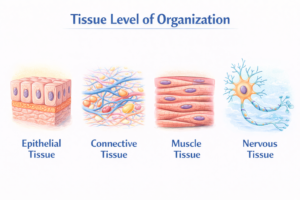
In animals, the tissue level of organization includes four basic tissue types. I often tell my students: “Remember these four, and half of biology becomes easy.”
1. Epithelial Tissue
Structure
- Cells are tightly packed
- Minimal intercellular space
- Rest on a basement membrane
Functions
- Protection
- Absorption
- Secretion
- Excretion
Examples
- Skin epidermis
- Lining of intestine
- Blood vessels
Teaching Tip: If a tissue lines, covers, or protects—think epithelial.
2. Connective Tissue
Structure
- Cells embedded in matrix
- Matrix may be fluid, semi-solid, or solid
Functions
- Binding and support
- Transport
- Protection
Types
- Loose connective tissue (areolar, adipose)
- Dense connective tissue (tendons, ligaments)
- Skeletal tissue (bone, cartilage)
- Fluid connective tissue (blood, lymph)
Classroom Insight: Students often forget blood is a connective tissue—remind them that transport is a form of connection.
3. Muscular Tissue
Structure
- Elongated muscle fibers
- Contractile proteins (actin & myosin)
Functions
- Movement
- Posture
- Circulation
Types
- Skeletal muscle
- Smooth muscle
- Cardiac muscle
Memory Trick I Teach:
- Skeletal = voluntary
- Smooth = involuntary
- Cardiac = rhythmic & involuntary
4. Nervous Tissue
Structure
- Neurons and neuroglial cells
- Highly specialized
Functions
- Transmission of nerve impulses
- Coordination and control
Location
- Brain
- Spinal cord
- Nerves
Teaching Insight: Nervous tissue does not work alone—it controls all other tissues.
Also Read- Structure and Functions of Cell | Transport, Division & Junctions
Tissue Level of Organization in Plants
Although students often focus on animals, plants also show a clear tissue level of organization.
Types of Plant Tissues
1. Meristematic Tissue
- Actively dividing
- Found at growing regions
2. Permanent Tissue
- Simple (parenchyma, collenchyma, sclerenchyma)
- Complex (xylem, phloem)
From Experience: Once students link xylem with water transport and phloem with food transport, plant biology becomes intuitive.
Difference Between Cellular and Tissue Level of 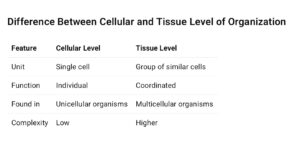
Also Read- BASIC LIFE PROCESSES | HOMEOSTASIS | ANATOMICAL TERMINOLOGY
Real-Life Examples of Tissue Level of Organization
- Muscle tissue enabling walking
- Nervous tissue allowing reflex actions
- Epithelial tissue protecting skin
- Xylem transporting water in trees
These examples help students connect theory to real life.
Common Student Mistakes (Based on Teaching Experience)
- Confusing tissues with organs
- Forgetting plant tissues
- Memorizing without understanding functions
- Ignoring diagrams
My advice: Always study tissues with labeled diagrams and functions together.
Tissue Level of Organizatio Exam Tips
- Practice diagrams regularly
- Write definitions precisely
- Include examples in answers
- Use flowcharts for long answers
These strategies consistently improve exam scores.
Unit 1 Human Anatomy And Physiology 1 – All Chapter PDF Notes
Frequently Asked Questions (FAQ)
Q1. What is meant by tissue level of organization?
The tissue level of organization refers to groups of similar cells working together to perform a specific function in multicellular organisms.
Q2. How many types of tissues are there in animals?
There are four types: epithelial, connective, muscular, and nervous tissues.
Q3. Do plants show tissue level of organization?
Yes, plants show well-developed tissue organization including meristematic and permanent tissues.
Q4. Why is tissue level important?
It allows specialization, efficiency, and forms the basis for organs and organ systems.
Q5. Is tissue level present in unicellular organisms?
No, unicellular organisms show only cellular level organization.
Also Read- ANATOMY AND PHYSIOLOGY | INTRODUCTION TO HUMAN BODY

Pingback: Integumentary System: Structure and Functions of Skin
Pingback: Skeletal System: Bones, Muscles & Contraction Explained